
Blog

What Is a Screenplay? The Complete Guide for Indian Filmmakers

A screenplay is the written blueprint of a film. It defines every scene, every line of dialogue, and every visual action the camera captures. Every film produced by Dharma Productions, Maddock Films, or any Mollywood banner begins with a screenplay. Without it, no director, cinematographer, or actor can begin their work.

A screenplay is not a novel. A screenplay contains no internal monologue, no narrative prose, and no description of what a character feels unless that feeling appears visibly on screen. A screenplay is built entirely from what a camera can see and what a microphone can hear.

Indian independent filmmakers writing their first screenplay need to master three things: format, structure, and purpose. The format is standardized globally. The structure follows a three-act progression. The purpose is to communicate the complete film to every person in the production pipeline before a single rupee is spent on crew or equipment.

Screenplay concept with Indian film characters collage

What Does a Screenplay Contain?

A screenplay contains five mandatory elements: scene headings, action lines, character names, dialogue, and transitions.

Scene headings — also called sluglines — define whether a scene is interior or exterior, identify the location, and state the time of day. INT. MUMBAI APARTMENT — NIGHT is a standard slugline. Action lines describe what the camera sees and are always written in present tense. Character names appear centred above each dialogue block. Dialogue is the spoken text and is mandatory for revealing character and advancing plot. Transitions such as CUT TO: or FADE OUT. indicate scene changes; modern screenplays use them sparingly.
What Is the Three-Act Structure in a Screenplay?

The three-act structure is the dominant framework for commercial film screenwriting worldwide.

Act One (25–30 pages) introduces the protagonist, their world, and the central conflict. It ends with an inciting incident. Act Two (50–60 pages) escalates obstacles, develops character arcs, and builds toward crisis. The midpoint shifts the protagonist's position. The act closes with the darkest moment. Act Three (25–30 pages) delivers the climax, resolves the conflict, and closes all character arcs.

How Is a Screenplay Different from a Novel or Stage Script?

A screenplay differs from a novel in one fundamental way: a screenplay shows; a novel tells.

A novel describes what a character thinks. A screenplay shows only what the camera captures. A stage script serves a live performance with flexible staging. A screenplay serves a locked visual medium with fixed frame dimensions. The table below defines the differences:

Document
Medium
Format
Timing Rule
Novel
Print
Prose narrative
None
Stage Script
Theatre
Variable by convention
None
Screenplay
Film / OTT
Standardised industry format
1 page = 1 minute

Novel

Medium
Format
Print
Prose narrative
Timing Rule
None

Stage Script

Medium
Format
Theatre
Variable by convention
Timing Rule
None

Screenplay

Medium
Format
Film / OTT
Standardised industry format
Timing Rule
1 page = 1 minute

What Screenplay Software Do Indian Filmmakers Use?

Indian filmmakers use Final Draft, Celtx, WriterDuet, and Fade In as their primary screenplay writing tools. Final Draft costs approximately ₹15,000–₹20,000 for a perpetual licence. Celtx offers a freemium web-based plan. WriterDuet is collaborative and runs in-browser.

Standalone screenplay writing software India filmmakers rely on requires significant additional tools to complete the production pipeline. A filmmaker writing in Celtx must manually rebuild the scene breakdown in a spreadsheet, transfer that data into a scheduling tool, and then create call sheets separately. This manual transfer consumes 15–25% of pre-production time on a typical indie film.

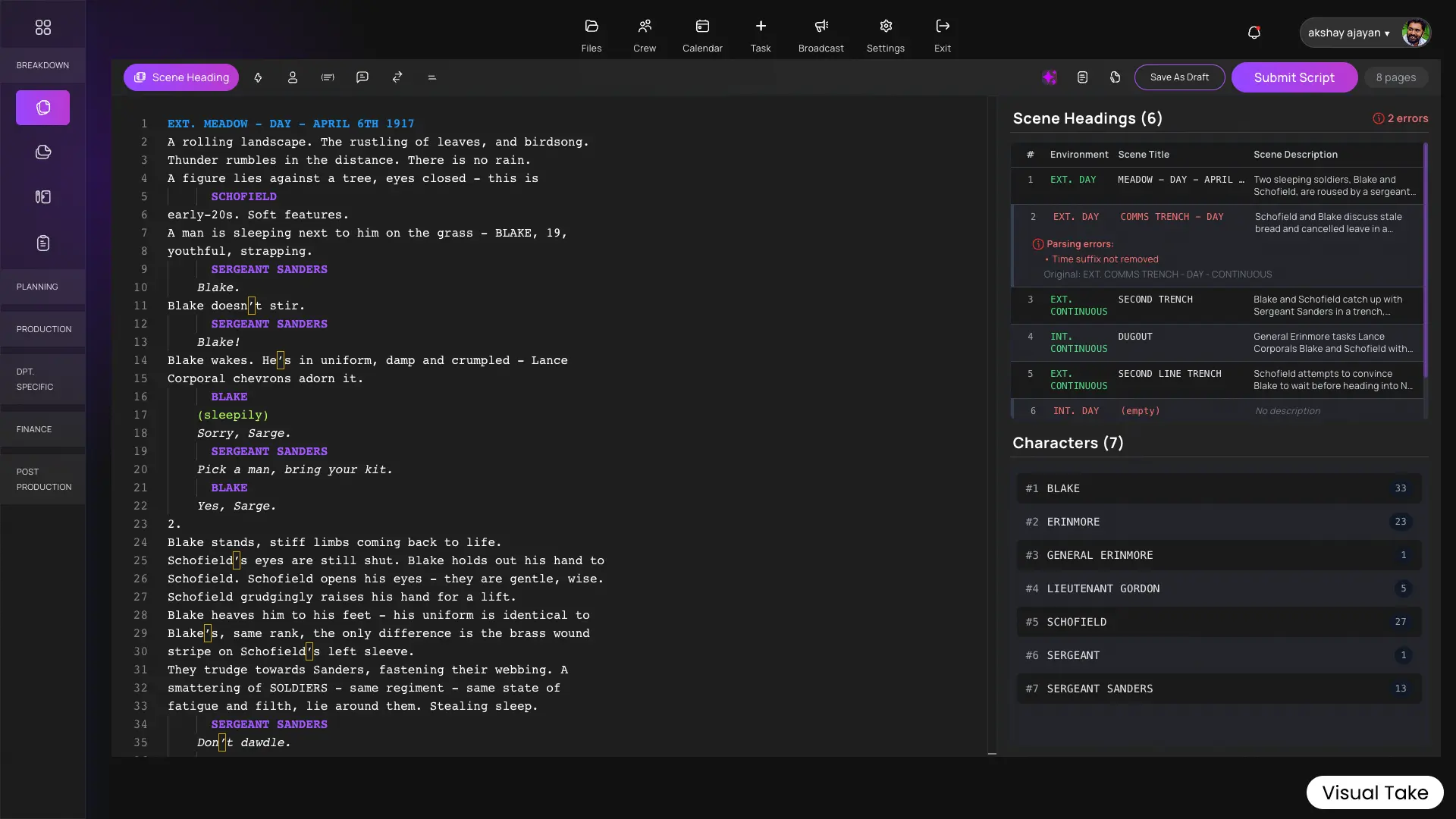
VisualTake by Movytech is a film production management tool built specifically for Indian filmmakers. VisualTake integrates screenplay breakdown, shot listing, storyboarding, and production scheduling in a single script-to-screen SaaS India platform. Movytech is a DPIIT-recognised startup incubated at Technopark, Thiruvananthapuram. VisualTake eliminates the data transfer overhead that disconnected tools create for regional cinema production teams across Malayalam, Tamil, Kannada, and Telugu projects.

Screenplay Breakdown Interface – Visual Take

Screenplay breakdown interface showing script and scene details

Why Does Screenplay Format Matter for Indian Productions?

Screenplay format matters because every production department reads the same document.

A line producer uses the screenplay for scene breakdown software to extract budgeting inputs. A cinematographer reads action lines to plan lighting ratios and camera movement. A production designer extracts location, prop, and set requirements from the same pages. Non-standard formatting creates ambiguity. Ambiguity causes production delays. On a ₹1 crore indie film, a single day of delay costs ₹3–5 lakh in crew and equipment costs. Standard screenplay format is mandatory before any script reaches the production stage.

The industry-standard format requires Courier 12pt font, 1-inch margins, and the specific layout of sluglines, action lines, and dialogue blocks that professional screenplay writing guides define.

How Does a Screenplay Connect to the Full Pre-Production Pipeline?

A screenplay is the first document in the complete pre-production pipeline.

After the screenplay locks, the production team performs a script breakdown — identifying every character, location, prop, costume, and special effect required per scene. The script breakdown generates the shooting schedule. The shooting schedule determines the production budget. The production budget drives the financing conversation.

In Indian film production, this pipeline moves from screenplay to breakdown to call sheet generation to shot list creation. Each stage depends on the accuracy of the one before it. Film scheduling tools and scene breakdown software — such as the pre-production modules inside VisualTake — automate this pipeline and eliminate manual data entry across departments.

OTT platforms including Netflix India, Amazon Prime Video India, and ZEE5 require formatted screenplays and structured production documentation as part of their content acquisition process. Independent filmmaker software India studios use must support these documentation standards to qualify for OTT pitches and co-production financing rounds.

What Is the Final Answer: What Is a Screenplay?

A screenplay is the mandatory written document that defines every scene, character, line of dialogue, and visual action in a film. It is the central communication tool for every production department. It follows a standardized format where one page equals one minute of screen time. It structures the narrative using the three-act framework. It is the first and most critical deliverable in the pre-production pipeline — for a ₹50 lakh short film and a ₹100 crore feature alike.

Indian filmmakers who need screenplay writing software that connects directly to a full film production management tool and pre-production workflow should evaluate VisualTake by Movytech as the integrated alternative to disconnected desktop applications.


VisualTake film production banner with camera and spotlight