Blog

What are advanced workflow tools in film production?

Advanced workflow tools in film production are defined as integrated software platforms that manage pre-production, production, and post-production within a single system. These tools eliminate fragmented communication, reduce manual dependency, and ensure real-time coordination across departments. Tools like Visual Take, Celtx, Yamdu, and StudioBinder are industry-recognized platforms that centralize scriptwriting, scheduling, budgeting, and crew management.

Advanced workflow tools replace spreadsheets, emails, and paper-based tracking. They create a unified production environment. This approach reduces budget overruns and missed deadlines. The global AI in Film market is projected to reach USD 14.1 billion by 2033, driven by tools that automate script analysis, scheduling, and production planning.

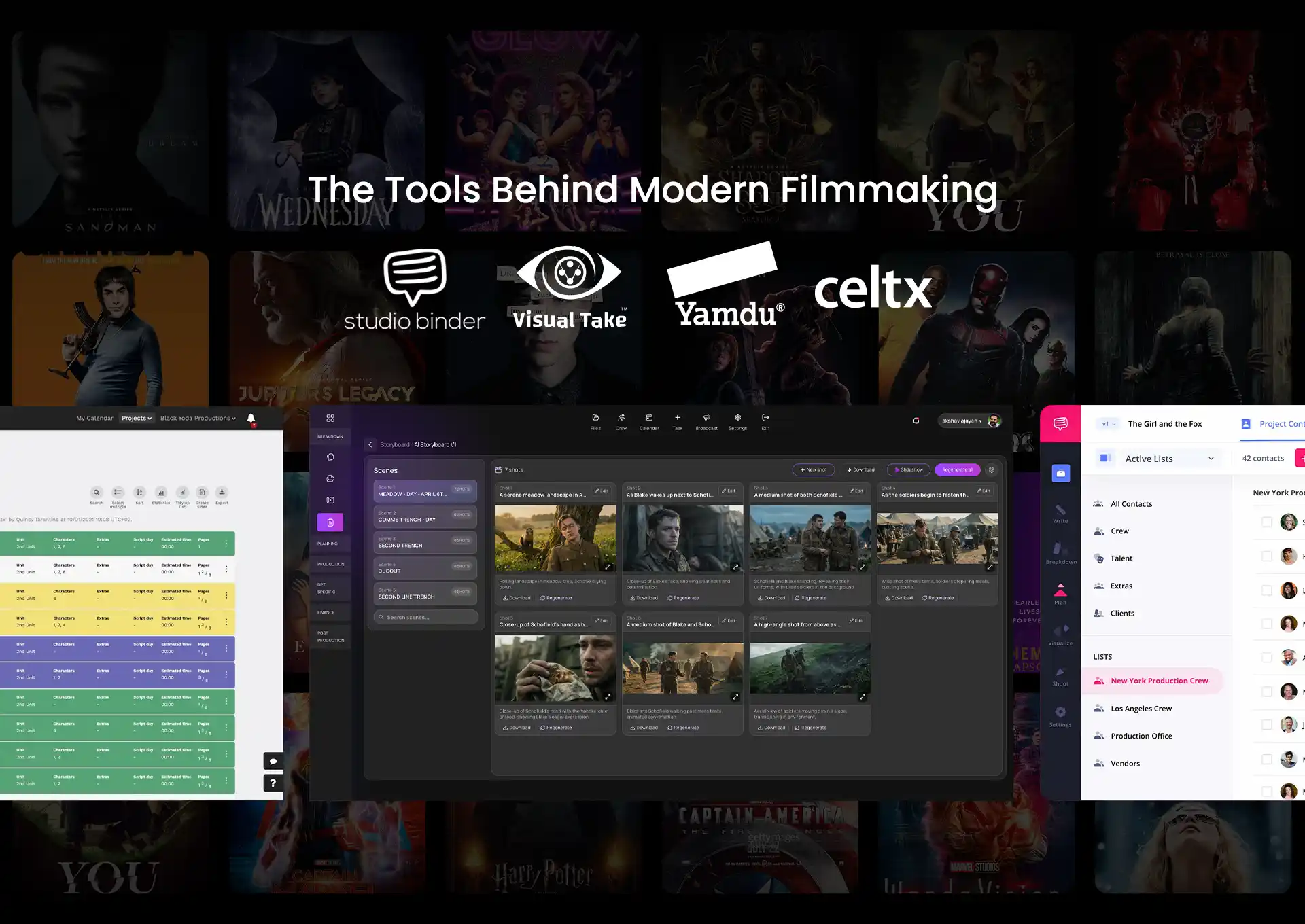
Visual Take functions as a centralized production system. It connects script development, crew coordination, and production tracking in one platform. Celtx provides structured screenwriting and breakdown tools. Yamdu focuses on budgeting and resource allocation. StudioBinder delivers call sheets and shooting schedules. These tools define the modern filmmaking workflow.

Advanced workflow tools in film production featuring Visual Take, StudioBinder, Yamdu, and Celtx dashboards for scriptwriting, scheduling, and crew management

How do advanced workflow tools improve script development?

Script development tools like Celtx and Visual Take are defined as software systems that structure screenplay formatting, character breakdown, and scene organization.

Celtx provides industry-standard screenplay formatting. It ensures consistency across drafts. It includes character breakdowns and scene indexing. Visual Take extends this capability with AI-powered script extraction. It identifies characters, props, and locations automatically.

AI script tools require structured input scripts. They generate breakdown reports within minutes. This reduces manual effort. It eliminates human error.

AI-powered scriptwriting software supports brainstorming and dialogue generation. It improves narrative consistency. It accelerates writing cycles. Script tools are mandatory for productions above ₹1 crore budgets. They ensure professional formatting and structured planning.

How do workflow tools optimize pre-production planning?

Pre-production tools like Visual Take, Yamdu, and StudioBinder are defined as systems that automate script breakdown, scheduling, budgeting, and resource allocation.

Visual Take performs AI-driven script breakdown. It identifies props, costumes, cast, and locations. This process requires structured screenplay input. It generates visual breakdown sheets.

Yamdu provides budgeting tools. It tracks expenses in INR. It supports budget planning for ₹5 lakh indie films and ₹100 crore commercial projects. StudioBinder generates call sheets and production calendars.

AI scheduling tools require inputs like crew availability, location access, and equipment lists. They generate optimized shooting schedules. This reduces downtime. It improves resource utilization.

Pre-production tools are mandatory for multi-location shoots. They ensure efficient coordination.

How do workflow tools improve production management?

Production management tools like Visual Take and StudioBinder are defined as platforms that coordinate crew, tasks, communication, and daily operations during filming.

Visual Take provides crew management and task tracking. It assigns responsibilities. It tracks progress in real time. StudioBinder manages call sheets and daily schedules.

These tools require centralized dashboards. They provide visibility to directors, producers, and crew members. They eliminate communication gaps.

Broadcast and communication features ensure instant updates. They replace fragmented WhatsApp groups and email threads. This improves coordination across departments.

Production tools reduce delays. They ensure adherence to schedules. They are mandatory for projects with large crews exceeding 50 members.

How do workflow tools reduce budget overruns?

Budget management tools like Visual Take and Yamdu are defined as systems that track expenses, allocate resources, and monitor financial performance.

Visual Take supports INR-based budgeting. It tracks costs for equipment, crew salaries, and logistics. It provides real-time budget updates.

These tools require predefined budget structures. They compare planned vs actual expenses. They identify cost overruns early.

AI-driven budgeting tools optimize resource allocation. They reduce wastage. They improve financial control.

Budget tools are mandatory for productions above ₹10 lakh. They ensure financial discipline.

How do workflow tools enable collaboration in filmmaking?

Collaboration tools like Visual Take and Celtx are defined as cloud-based systems that enable real-time teamwork across departments.

Visual Take supports centralized file management. It stores scripts, schedules, and production data. Celtx allows multiple writers to work simultaneously.

Cloud-based filmmaking ensures version control. It eliminates confusion from multiple file versions. It improves workflow efficiency.

Collaboration tools are mandatory for distributed teams. They support modern production environments.

How do workflow tools support indie filmmakers?

Low-budget tools like Celtx free version and AI trial platforms are defined as accessible solutions for independent filmmakers.

Celtx offers free screenwriting features. It reduces entry barriers. AI tools provide script assistance and breakdown automation.

Indie filmmakers working on ₹5–₹20 lakh budgets benefit from these tools. They achieve higher production quality with limited resources.

Workflow tools reduce dependency on large teams. They enable solo creators and small crews.

These tools are mandatory for indie filmmakers seeking efficiency and scalability.

What is the future of workflow tools in filmmaking?

The future of workflow tools is defined by AI integration, automation, and cloud-based collaboration.

AI tools will automate scriptwriting, scheduling, and budgeting. They will reduce manual intervention. They will improve accuracy.

Cloud platforms will enable global collaboration. Production teams will work across countries seamlessly.

The AI in Film market growth from USD 1.8 billion in 2024 to USD 14.1 billion by 2033 confirms this shift.

Workflow tools will become mandatory for all productions. They will define the standard filmmaking process.


Conclusion

Advanced workflow tools are defined as essential systems for modern film production. They centralize operations. They automate processes. They improve efficiency.

Tools like Visual Take, Celtx, Yamdu, and StudioBinder are industry standards. They support script development, pre-production, production management, and budgeting.

These tools are mandatory for scalable, efficient filmmaking. They reduce costs. They improve coordination. They enable creative focus.

Modern filmmaking requires intelligent systems. Advanced workflow tools deliver that capability.

VisualTake film production banner with camera and spotlight