Blog

Script Breakdown in Film Production The Complete Pre-Production Guide for Indian Filmmakers

Script breakdown is the systematic dissection of a screenplay into categorised production elements — characters, props, locations, costumes, stunts, and sound — that drive every downstream pre-production decision. Without a complete breakdown, no shooting schedule, call sheet, or film budget can be accurate.

Manual breakdown processes introduce errors that cost Indian film productions between ₹2 lakh and ₹15 lakh in avoidable delays. VisualTake automates this process, converting a locked script into a categorised element list in minutes and connecting every pre-production document to a single source of truth: the script.

Indian filmmakers working across Bollywood, Malayalam cinema, Tamil film industry, and Telugu OTT productions require a structured breakdown before a single camera rolls. A missed element in breakdown translates directly into a missed shooting day — and missed shooting days are among the most expensive errors in film production.

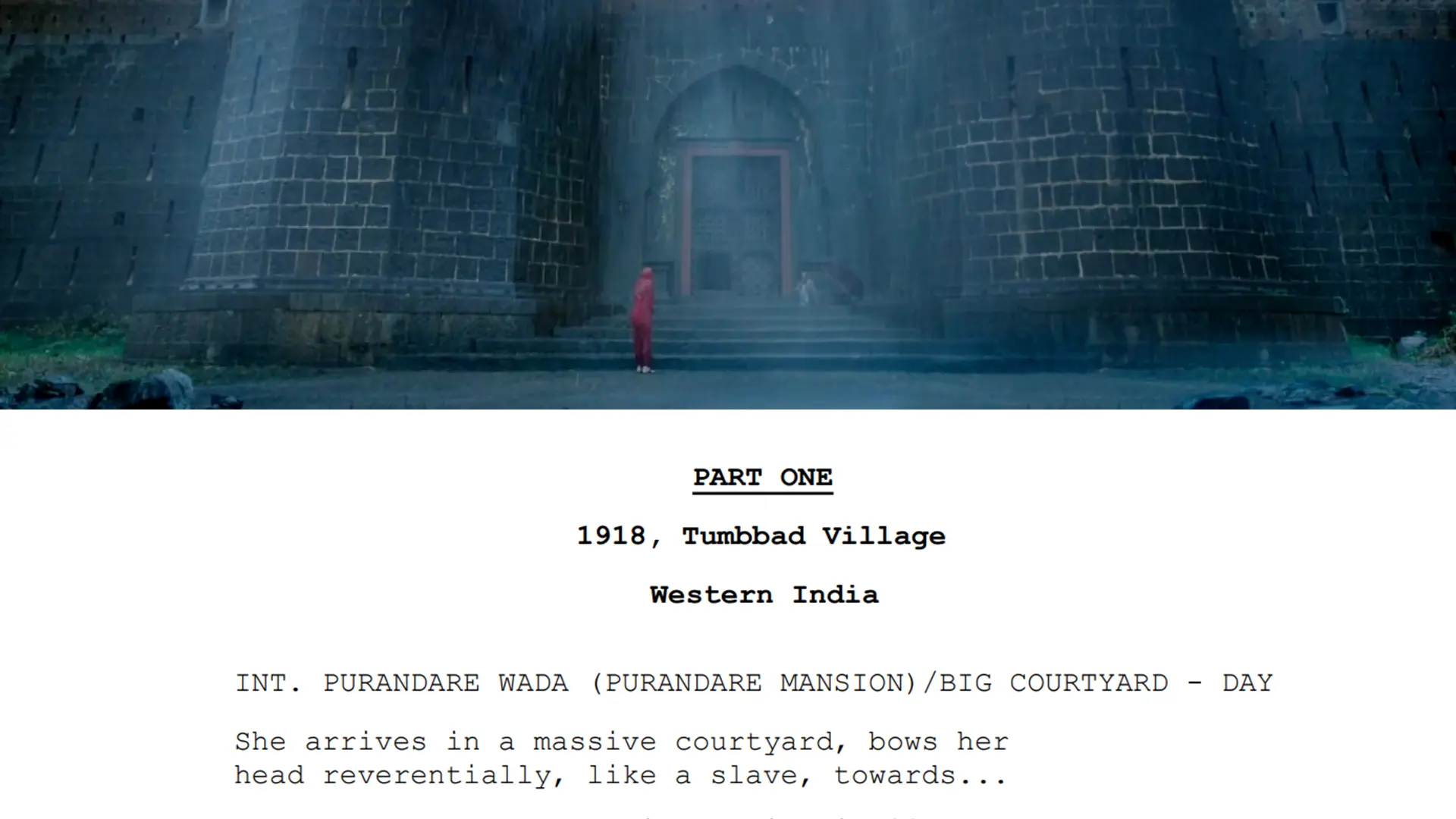
Tumbbad script page with courtyard scene and character approaching mansion entrance.

What Is a Script Breakdown in Film Production?

Script breakdown is the scene-by-scene identification and cataloguing of every production element present in a screenplay. It is the foundation of film production management — not a preparatory step, but the primary planning document from which all other documents are derived. Every shot list, call sheet, location scout, and production budget originates from the breakdown.

A breakdown document organises the screenplay into individual scenes. Each scene receives its own breakdown sheet recording the scene number, scene heading, page count, interior or exterior designation, day or night designation, and a categorised list of every element present. VisualTake generates these sheets automatically from an uploaded script, removing the manual process that traditionally requires an assistant director 40 to 80 hours on a feature film.


Why Must Script Breakdown Work Scene by Scene?


Indian film productions operate across multiple languages, locations, and unit configurations simultaneously. A Malayalam film shooting in Munnar, Kochi, and Dubai within the same schedule cannot rely on a single overview document. Each scene carries unique requirements. A scene in Munnar requires different location permits, different crew call times, and different costume continuity tracking than a scene shot at a Kochi studio.

Scene-by-scene breakdown is mandatory for accurate film budgeting, accurate scheduling, and accurate department-specific task allocation. Budgets fail at the scene level — and the breakdown is where those failures are caught before production begins.

What Elements Does a Complete Script Breakdown Identify?

A complete script breakdown identifies the following element categories. VisualTake tracks all of them within its production management platform:

Characters: Principal actors, supporting cast, extras, and background performers. Character tracking connects directly to casting management workflows, recording speaking roles, non-speaking roles, and stunt doubles per scene.

Locations: Interior and exterior locations with time-of-day designation. Integrating location scouting data into the breakdown sheet reduces coordination errors between the location manager and assistant director.

Props: Physical items handled by actors or required within frame. Props missed in breakdown generate last-minute procurement costs that typically run 30% to 70% above planned rates.

Costumes and Wardrobe: Character wardrobe items including continuity tracking across scenes. VisualTake flags costume continuity issues across non-linear shooting sequences.

Makeup and Hair: Specific makeup effects, prosthetics, and hair requirements. Standard prosthetic applications require 3 to 5 hours of prep time; complex full-character prosthetics can exceed 8 hours. Advance identification in the breakdown is essential for both scheduling and budget accuracy.

Special Effects and VFX: Practical effects including pyrotechnics, rain rigs, and wire work, alongside post-production CGI requirements flagged for the VFX supervisor.

Sound: Special sound requirements, music cue placements, and live recording designations. Sound-critical scenes that require playback operators or specialist location sound crew must be flagged at the breakdown stage.

Set Dressing: Background items that define the environment. Set dressing breakdown prevents the art department from furnishing sets in conflict with established scene continuity.

Vehicles and Animals: All vehicles including specialised transport, and any live animals or animal handlers. Animal performance scenes in India require advance compliance with AWBI (Animal Welfare Board of India) requirements.

Stunts: High-risk sequences requiring stunt coordinator involvement. Stunt scenes must be flagged for safety review before the schedule is finalised.

Production Design Elements: Structural builds, set construction requirements, and visual design specifications tied to the production designer's plan.
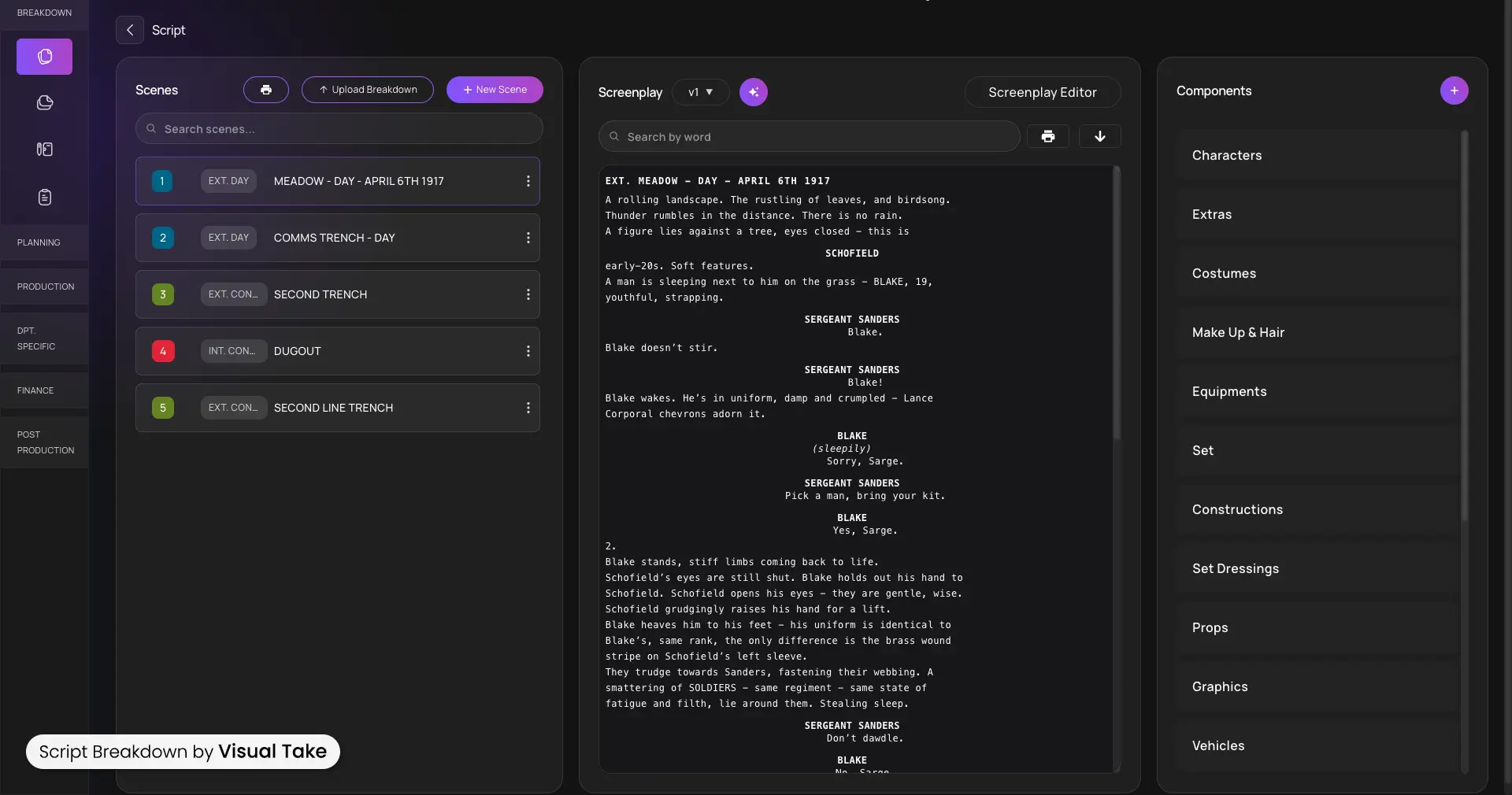
AI-powered script breakdown dashboard with scenes, screenplay editor, and production elements for film planning.

How Does Color Coding Work in a Professional Script Breakdown?

Color coding in script breakdown is a standardized visual system that assigns a specific color to each element category, enabling any department head to scan a marked-up script and immediately identify elements relevant to their department.

Element Category
Standard Color
What It Covers
Characters
Red
Principal actors, speaking roles, and stunt doubles
Stunts
Orange
High-risk sequences requiring specialized stunt coordination
Silent Performers
Yellow
Non-speaking background performers with defined actions
Atmospheric Extras
Green
Background extras contributing to scene ambiance
Props
Purple
Physical items handled by actors or essential to the scene
Costumes / Wardrobe
Brown
Character wardrobe items and continuity tracking
Makeup and Hair
Pink
Special makeup effects, prosthetics, and hair requirements
Special Effects / VFX
Grey
Practical effects and post-production visual effects flags
Sound
Black
Sound requirements, music cues, and audio effects
Set Dressing
Light Blue
Background decor defining the scene environment
Vehicles
Dark Green
Cars, trucks, and specialized transport requirements
Animals
Tan
Live animals and animal handlers needed per scene

Characters

Standard Color
What It Covers
Red
Principal actors, speaking roles, and stunt doubles

Stunts

Standard Color
What It Covers
Orange
High-risk sequences requiring specialized stunt coordination

Silent Performers

Standard Color
What It Covers
Yellow
Non-speaking background performers with defined actions

Atmospheric Extras

Standard Color
What It Covers
Green
Background extras contributing to scene ambiance

Props

Standard Color
What It Covers
Purple
Physical items handled by actors or essential to the scene

Costumes / Wardrobe

Standard Color
What It Covers
Brown
Character wardrobe items and continuity tracking

Makeup and Hair

Standard Color
What It Covers
Pink
Special makeup effects, prosthetics, and hair requirements

Special Effects / VFX

Standard Color
What It Covers
Grey
Practical effects and post-production visual effects flags

Sound

Standard Color
What It Covers
Black
Sound requirements, music cues, and audio effects

Set Dressing

Standard Color
What It Covers
Light Blue
Background decor defining the scene environment

Vehicles

Standard Color
What It Covers
Dark Green
Cars, trucks, and specialized transport requirements

Animals

Standard Color
What It Covers
Tan
Live animals and animal handlers needed per scene

Every department head — from the production designer at a Hyderabad studio to the costume supervisor on a web series for Amazon Prime India or Netflix India — works from a color-coded breakdown that reflects their specific element category. This eliminates cross-department miscommunication that generates avoidable reshoots.

How Does Script Breakdown Work for Regional Cinema and OTT Productions?

Regional cinema productions across banners in Kerala, Tamil Nadu, Andhra Pradesh, and Karnataka require breakdown documentation that reflects the specific production structure of South Indian filmmaking — multi-location schedules, large background cast counts, and extended action sequences.

OTT productions add a layer of complexity that single-film breakdown tools are not designed to handle. A web series running 8 episodes with 120 scenes requires breakdown documentation that tracks element continuity across episodes, not just across scenes. Cross-episode continuity errors — props that appear, disappear, or change between episodes — are among the most expensive problems in Indian OTT production because they require patch shoots after picture lock.

For independent filmmakers operating on budgets between ₹15 lakh and ₹1.5 crore, professional-grade scene breakdown tools must be accessible without the overhead of a full production coordinator. VisualTake is built for this requirement: breakdown sheets, shot lists, and scheduling outputs generated from the same uploaded script file, at a price point accessible to independent productions.

What Happens When Filmmakers Skip the Script Breakdown Process?

Productions that skip script breakdown encounter budget overruns, scheduling failures, and continuity errors that require costly reshoots. Missing a single prop in the breakdown does not produce a minor inconvenience — it produces a halted shooting day.

A halted shooting day on an Indian feature film with a 60-person crew costs between ₹8 lakh and ₹40 lakh depending on the scale of production. The cost of a thorough breakdown — in time or in software — is a fraction of a single unplanned idle day.

Skipping breakdown also destroys cast scheduling accuracy. An actor booked for days 3 and 7 of a shoot requires the AD to confirm that all scenes involving that actor are grouped correctly. Without a complete scene-by-scene element list, actors are called unnecessarily, generating talent fees for idle days. For productions with principal cast commanding ₹25 lakh to ₹1 crore per day, unnecessary call days represent direct, unrecoverable financial loss.

VisualTake's scheduling and call sheet generator builds the shooting schedule directly from the breakdown data. Every call sheet reflects the confirmed element list for that shooting day, with conflicts flagged before production costs are incurred.

The Script Breakdown Is the Foundation of Every Production Decision

Script breakdown is not a best practice — it is the structural prerequisite for accurate budgeting, accurate scheduling, accurate department coordination, and accurate call sheet generation. Whether the production is a ₹20 lakh Malayalam short film targeting IFFK selection or a ₹50 crore Telugu action feature targeting pan-India theatrical release, the breakdown process remains identical in structure. Only the scale changes.

VisualTake delivers this capability as a production management platform built specifically for the Indian film industry — replacing spreadsheets, physical breakdown sheets, and manual color-coded scripts with a digital system that connects every pre-production document to a single source of truth: the locked script.

VisualTake film production banner with camera and spotlight