Blog

Scene Breakdown: The System Behind Every Film Shoot

Scene breakdown is the foundation of film production planning. It defines every resource, cost, and scheduling decision before the shoot begins. A scene breakdown is defined as a structured extraction of all production elements from a script, used to control budget, scheduling, and execution. Every professional production—whether in Bollywood, Mollywood, or Hollywood—requires a scene breakdown before pre-production can proceed.

Scene breakdown determines how much a film costs, how long it takes to shoot, and how departments coordinate. Production houses like Aashirvad Cinemas or Dharma Productions depend on this process to avoid budget overruns that can exceed ₹50 lakh per day on large sets. Film production software such as Movie Magic Scheduling and StudioBinder automates this process, but the logic remains the same: identify, categorize, and execute.

Scene breakdown converts a script into an actionable production system. Without it, production becomes unpredictable, delays increase, and costs escalate.

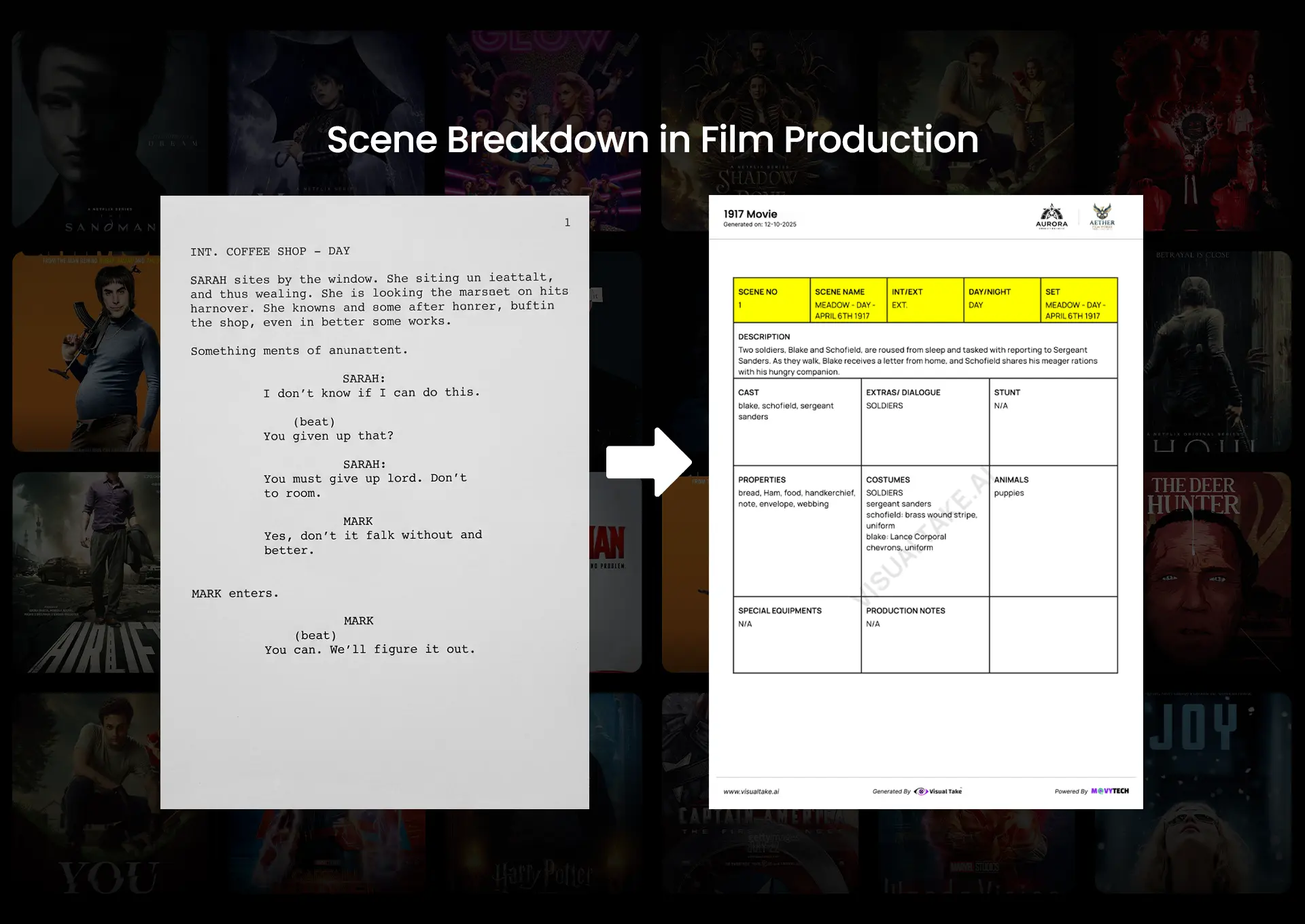
Scene breakdown in film production showing script to structured production sheet with cast, props, and scheduling details

What is a scene breakdown in film production?

Scene breakdown is a detailed inventory of all elements required to execute a scene. It includes cast, props, costumes, locations, and technical requirements.

Scene breakdown extracts data directly from the shooting script and organizes it into production categories. The 1st Assistant Director is responsible for creating this document in most film industries, including Malayalam cinema and Hindi cinema.

Each scene breakdown contains:

  • Cast members (lead actors, junior artists, stand-ins)
  • Props (handheld and set props)
  • Costumes (character-specific wardrobe)
  • Set dressing (environmental elements)
  • Makeup and hair requirements
  • Special effects (practical and VFX cues)
  • Sound elements
  • Vehicles and animals

Scene breakdown acts as the base layer for:

  • Budget planning (INR allocation per scene)
  • Stripboard scheduling
  • Shooting day estimation
  • Department coordination

Without scene breakdown, no production schedule can be finalized.

Why is scene breakdown mandatory for film production?

Scene breakdown is mandatory because it controls cost, time, and coordination.

Scene breakdown ensures that every department knows its exact responsibility before the shoot begins. Film industries like Mollywood operate on tight schedules and controlled budgets, often between ₹5 crore and ₹20 crore for mid-scale films. Any missing element in planning results in reshoots or delays.

Scene breakdown prevents:

  • Budget overruns
  • Schedule conflicts
  • Missing props or costumes
  • Miscommunication between departments

Scene breakdown also enables parallel planning. For example:

  • The costume department prepares outfits based on tagged scenes
  • The production team allocates INR budgets per scene
  • The assistant director builds a shooting schedule

Production software like Celtx and StudioBinder integrates breakdown data into scheduling systems, making execution faster and more accurate.

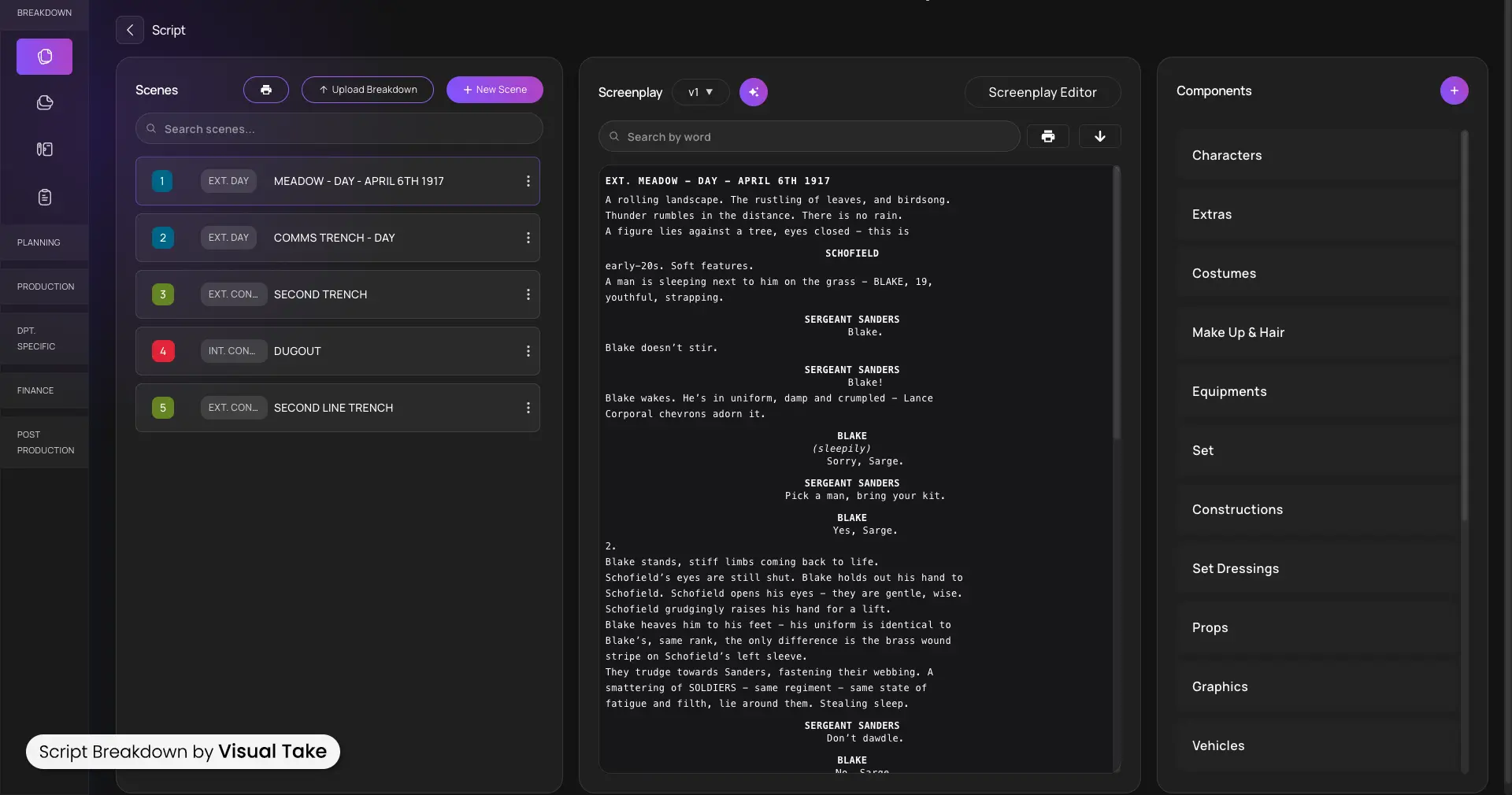
Film production script breakdown software interface showing scene list, screenplay editor, and categorized production elements like props, costumes, and cast

How do you create a scene breakdown step by step?

Scene breakdown requires a structured five-step process that converts a script into production data.

1. What is required before starting a scene breakdown?

Shooting script is required before starting a scene breakdown.

Shooting script must be finalized, formatted, and locked. Any change after breakdown creation results in rework across departments. Slug lines, character names, and action blocks must be clearly defined.

Professional productions do not begin breakdown without script lock.


2. How is script length measured for production planning?

Script length is measured using the “eighths of a page” method.

Eighth's system divides each script page into eight equal parts. This method estimates scene duration and shooting time.

Example:

  • 1 page = approximately 1 minute of screen time
  • 4/8 page = half-minute scene
  • 2/8 page = quick insert or cutaway

Production teams use this system to calculate:

  • Shooting days
  • Crew allocation
  • Equipment usage

This method is standard across industries including Hollywood and Indian cinema.


3. How are elements identified in a scene breakdown?

Elements are identified by tagging every production requirement in the script.

Tagging is defined as marking each item required for execution. This includes both explicit and implied elements.

Example:

If a character drinks tea:

  • Prop = cup
  • Set dressing = table
  • Costume continuity = same outfit
  • Sound = pouring liquid

Color coding is used for clarity:

  • Red = props
  • Blue = costumes
  • Green = set dressing

Modern tools like Movie Magic and StudioBinder allow digital tagging and automated categorization.


4. How are scene breakdown reports generated?

Scene breakdown reports are generated by organizing tagged elements into departments.

Reports include:

  • Cast report
  • Props report
  • Costume report
  • Location report
  • Production design report

Each report defines responsibility for a department. Clarity between categories is mandatory.

Example:

  • Prop = object used by actor
  • Set dressing = background object

Incorrect classification leads to delays on set.


5. How is a scene breakdown used by the production team?

Scene breakdown is used by sharing it across all departments for execution.

Scene breakdown must be distributed to:

  • Assistant directors
  • Production managers
  • Department heads

Each team reviews requirements and flags issues before shooting begins. This process ensures alignment.

Communication based on breakdown reduces on-set confusion and improves efficiency.
What tools are used for scene breakdown in modern production?

Scene breakdown uses specialized film production software to automate tagging, reporting, and scheduling.

Common tools include:

  • Movie Magic Scheduling
  • StudioBinder
  • Celtx
  • Final Draft (with tagging features)

These tools reduce manual work and integrate:

  • Budget tracking
  • Call sheet generation
  • Shooting schedules

Indian production houses increasingly adopt these tools to manage complex projects, especially OTT productions on platforms like Netflix and Amazon Prime.

What happens if scene breakdown is not done properly?

Scene breakdown failure leads to production delays, cost overruns, and coordination issues.

Common consequences include:

  • Missing props on set
  • Actor scheduling conflicts
  • Budget exceeding planned INR allocation
  • Increased reshoot costs

In large productions, a single missed element can cost lakhs per day. In Malayalam cinema, where schedules are tight, poor planning directly impacts release timelines.

Scene breakdown eliminates these risks by enforcing structure.

Conclusion

Scene breakdown is defined as the operational backbone of film production. It transforms a script into a controlled execution plan. Every successful film—whether produced in Mollywood, Bollywood, or global cinema—depends on this process.

Scene breakdown requires:

  • Script clarity
  • Detailed tagging
  • Structured reporting
  • Department coordination

Film production is not controlled by creativity alone. It is controlled by planning systems like scene breakdown.

VisualTake film production banner with camera and spotlight