Blog

Regional Film Genres Gaining Popularity in North India

The rules of Indian cinema have been rewritten. What was once a Bollywood-dominated landscape has transformed into a multi-polar market where regional content commands attention, budgets, and box office returns. For producers eyeing North India, the question is no longer whether to explore regional content—it's which genres, languages, and narratives will connect with audiences who increasingly demand stories rooted in their own cultural identity.

This report examines the data behind North India's regional content surge and provides actionable insights for production houses, independent filmmakers, and content strategists navigating this shifting terrain.

Regional Film Genres Gaining Popularity in North India

The Regional Content Explosion: What the Numbers Tell Us

The shift toward regional content isn't anecdotal—it's structural and accelerating. According to the FICCI-EY Media & Entertainment Report, regional content on OTT platforms has doubled from 27% of total streaming content in 2020 to 54% by 2024. This isn't a temporary trend; it reflects a fundamental change in how Indian audiences consume entertainment.

Consider the theatrical box office. In 2024, regional film industries collectively accounted for approximately 60% of India's box office share, while Hindi cinema's contribution fell to 40%. This represents a remarkable inversion from just a decade ago, when Hindi films dominated with roughly 80% of the top-grossing releases.

The production numbers reinforce this shift. India produced over 2,600 films in 2024 across various languages, with regional cinema (Telugu, Tamil, Kannada, and others) contributing more than 65% of total films produced. The Film Facilitation Office reported an 18% rise in shooting permissions compared to the previous year, indicating sustained production activity across regional markets.

For North India specifically, the Hindi film industry registered a steep 14% decline in production in 2024. The share of Hindi films in the overall mix dropped to 18%—the lowest over the last decade. Meanwhile, content in Haryanvi, Bhojpuri, Punjabi, and Rajasthani has emerged as a distinct growth segment that most producers still overlook.

North India's Dialect-First Revolution

The most compelling story in North Indian regional content isn't happening in traditional Hindi cinema. It's emerging from dialect-specific OTT platforms that have discovered underserved audiences numbering in the tens of millions.

Stage: The Fastest-Growing OTT Platform in India

Stage launched in 2019 focusing on Haryanvi content—the dialect spoken across Haryana—before expanding to Rajasthani and, in 2024, Bhojpuri. The results have been extraordinary. By early 2025, Stage reported 4.4 million paying subscribers on a base of over 20 million app installs. Its Annual Recurring Revenue hit ₹180 crore (approximately \$22 million) after a 289% surge in revenue and a 286% jump in subscribers in 2024.

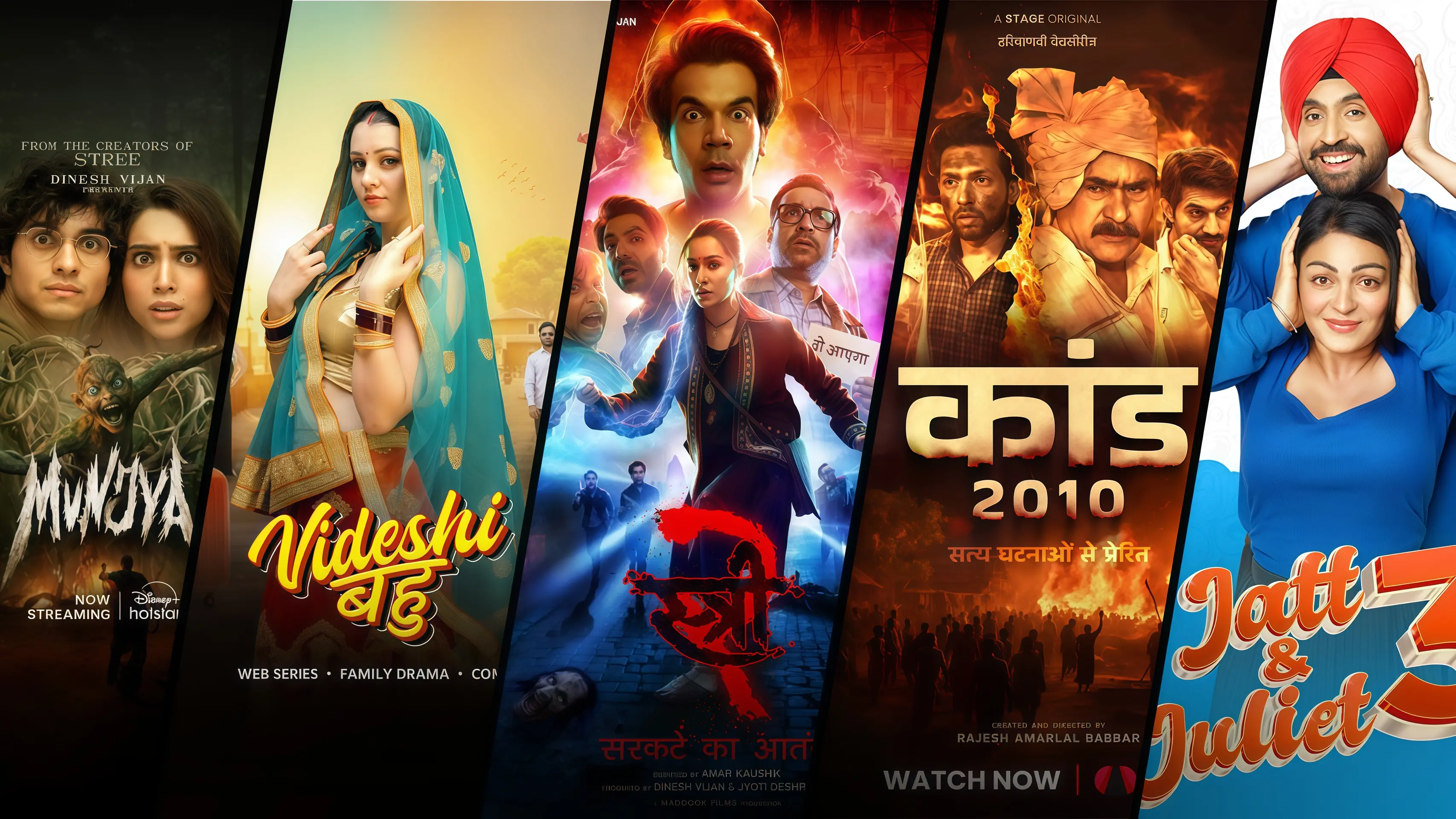
These numbers make Stage arguably India's fastest-growing OTT platform. The growth was fueled by original shows tailored to local culture: Haryanvi web series like Videshi Bahu and Kaand 2010, and Rajasthani drama Bhawani, which went viral in their respective markets. Stage also premiered Dada Lakhmi, a National Award-winning Haryanvi film, demonstrating that dialect audiences respond to premium content.

In March 2025, Stage raised \$12.5 million in Series B funding co-led by Goodwater Capital and Blume Ventures, with plans to expand into additional dialects including Marathi dialects and other Hindi belt languages. With Bhojpuri content just launched (the language has approximately 50 million speakers), Stage is positioned to unlock another massive user segment.

Chaupal: Multi-Lingual North Indian Content

Chaupal, launched by Pitaara TV in August 2021, operates as a multi-regional platform covering Punjabi, Haryanvi, and Bhojpuri content. Unlike Stage's dialect-first approach, Chaupal aggregates content across North India's linguistic diversity, offering movies, web series, podcasts, music, and documentaries.

The platform has secured strategic partnerships with Amazon Prime Video Channels to be offered as an add-on subscription in diaspora markets including Canada and New Zealand. Original series like Shahi Majra and Zila Sangrur have built dedicated fan bases, demonstrating that audiences exist for culturally specific storytelling beyond mainstream Hindi content.

What Producers Should Understand

These platforms aren't competing with Netflix or Amazon Prime Video for the same viewers. They're monetizing audiences that major OTT players have largely ignored—rural and semi-urban households in Haryana, Rajasthan, Bihar, eastern Uttar Pradesh, and Punjab who want to see their own dialects, landscapes, and social dynamics on screen.

Stage's monetization is 100% subscription-based with no advertising, using affordable household-level pricing to penetrate rural markets. The Haryanvi segment alone has turned cash-flow positive—a rare achievement for any Indian OTT platform. This proves that dialect audiences will pay for content that authentically represents their cultural identity.
Genre Trends Dominating North India: What's Working and Why

Understanding which genres are performing requires separating the Hindi belt's broader patterns from the specific preferences emerging in dialect markets.

Horror-Comedy: The Unexpected Franchise Builder

Hindi cinema's most consistent theatrical performer in recent years has been the horror-comedy genre. The success of Stree 2 (with a reported 12x return on budget) and Bhool Bhulaiyaa 3 established a formula that combines supernatural elements with small-town settings and comedic beats. Maddock Films has built an entire connected universe—the "Maddock Horror Comedy Universe"—that anchors long-term audience engagement across films.

This genre works particularly well for North Indian settings. The small-town milieu, folk horror elements rooted in local superstitions, and ensemble comedy appeal to audiences across urban and semi-urban markets. Productions like Munjya and Shaitaan exceeded trade expectations by leveraging these elements with modest budgets.

Rural Drama and Family Narratives

On dialect-specific platforms, the dominant genre is contemporary rural drama exploring family dynamics, social hierarchies, and community conflicts. Stage's biggest hits focus on relatable storylines: intercultural marriages (Videshi Bahu), local controversies (Kaand 2010), and social transformation.

These narratives work because they validate viewers' lived experiences. Unlike Hindi cinema's increasingly urban-centric storytelling, dialect content directly addresses the concerns, aspirations, and cultural tensions of Tier-2 and Tier-3 audiences.

Action and Mass Entertainment

The pan-India success of South Indian action films has influenced North Indian audience expectations. Films like Pushpa 2, Devara, and Kalki 2898 AD demonstrated that Hindi-speaking audiences respond enthusiastically to high-octane action when paired with compelling characters and regional authenticity.

For producers, the lesson isn't to replicate South Indian formulas but to recognize that mass entertainment—defined by scale, spectacle, and emotional stakes—still commands theatrical audiences. The challenge is executing these elements within reasonable budgets while maintaining cultural specificity.

Comedy and Sports

Survey data from Statista indicates that comedies and sports content rank as the top two preferred genres among Indian consumers for films and shows. This aligns with theatrical performance: mid-sized Hindi comedies like Madgaon Express and Laapataa Ladies found audiences through strong word-of-mouth despite limited marketing budgets.

Sports content, particularly cricket and kabaddi narratives, remains underexploited in regional markets despite consistent audience interest.

Production Intelligence: Using AI Tools to Navigate Regional Complexity

Managing production across multiple languages, dialects, and cultural contexts introduces complexity that traditional workflows struggle to handle. This is where production management technology becomes essential.

Visual Take: AI-Driven Production Management

Visual Take, developed by MovyTech, represents an emerging category of AI-powered film production suites designed to streamline pre-production through post-production. The platform offers automated scriptwriting assistance, scene analysis, intelligent budgeting, and scheduling tools that claim to reduce production costs and timelines by up to 30%.

For producers working across regional markets, Visual Take's capabilities address several pain points. The automated storyboarding feature transforms scripts into visual representations quickly, enabling faster creative alignment across distributed teams. AI-powered budgeting tools help forecast costs across different shooting locations and regional production contexts. Crisis management features help teams respond to the unpredictable challenges that frequently arise on regional productions.

MovyTech's ecosystem also includes Celegram (celebrity calendar management and collaboration) and Movycart (an e-commerce platform for production vendors and service providers), creating an integrated approach to production management.

Why Production Technology Matters for Regional Content

Regional productions often operate with leaner teams, tighter budgets, and compressed schedules compared to major Hindi productions. Technology that automates routine tasks—script breakdown, scheduling optimization, call sheet generation—allows limited production resources to focus on creative execution rather than administrative coordination.

The challenge for regional producers isn't just making content; it's making it efficiently enough to achieve positive returns at lower price points. Tools that reduce pre-production time and minimize budget overruns directly impact whether a regional project achieves profitability.

Conclusion

The data is unambiguous: regional content, particularly in North India's dialect markets, represents the highest-growth segment of Indian entertainment. Audiences numbering in the tens of millions want to see their languages, communities, and cultural identities represented on screen. They're willing to pay for this representation when content quality meets their expectations.

For producers, the opportunity is substantial but requires genuine commitment. Surface-level regional content fails. Authentic storytelling that emerges from deep understanding of specific communities succeeds. The production infrastructure—including AI-powered tools like Visual Take—exists to manage complexity at scale.

The question isn't whether to invest in North India's regional content market. The question is how quickly producers can develop the cultural fluency, production capabilities, and distribution relationships to capitalize on a transformation that's already well underway.


VisualTake film production banner with camera and spotlight